


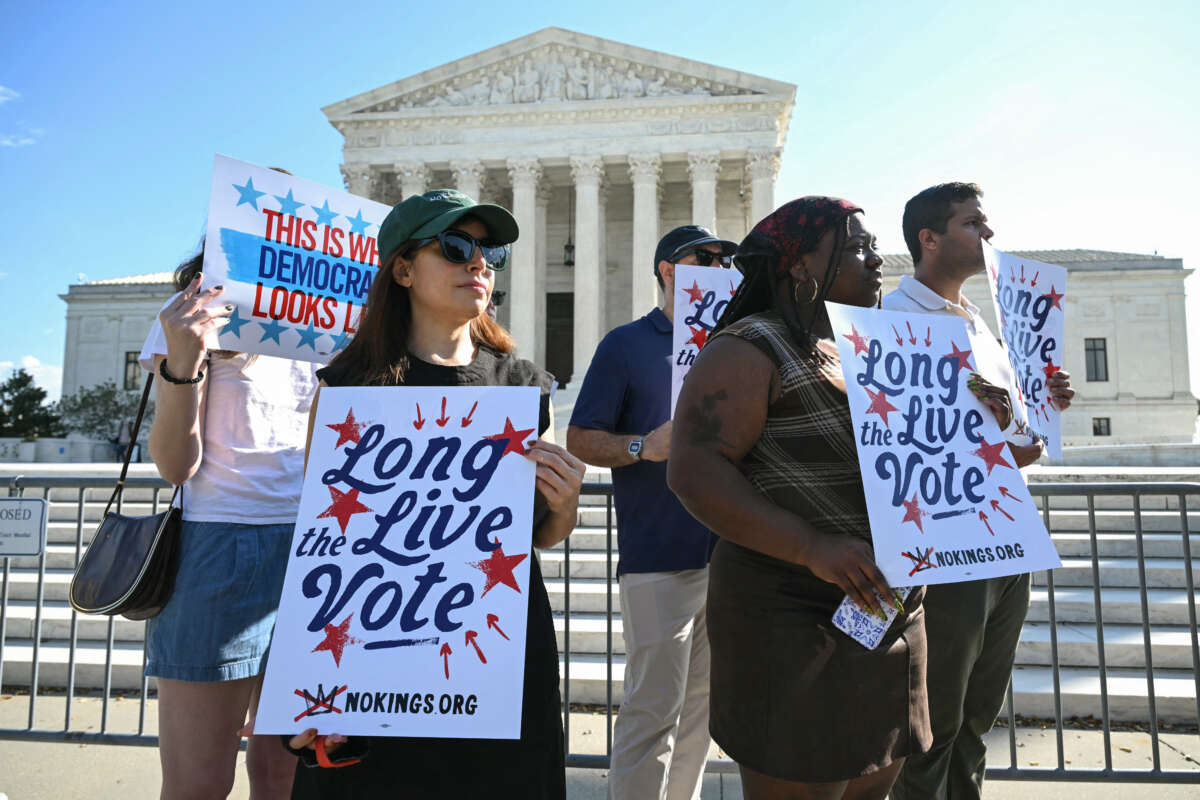
Attendees hold placards during a news conference about early voting in the midterm election, outside the US Supreme Court in Washington, DC, on October 14, 2026.
SAUL LOEB / AFP via Getty Images
The Roberts Court has dismantled guardrails preventing a president from turning state agencies against political rivals.
By Dan Canon , Truthout
Courts can create violence simply by putting words on paper. For anyone who has examined any legal system, this should not be a controversial proposition. Some observers argue that the very purpose of written judgments is to justify acts of violence. But one need not go that far to see the immediate effects: A judicial opinion can cause a death, ignite a civil war, legitimize a coup, or even wipe out an entire culture.
If we accept that basic truth, it should not surprise us that jurisprudence can also fuel election-related violence. In U.S. history, the most salient example is United States v. Cruikshank, an all-but-forgotten Reconstruction-era ruling. In Cruikshank, the Supreme Court held that the federal government could not prosecute the broad-daylight massacre of dozens of Black Republicans in 1873, most of whom were defending political offices duly won by their candidates. After two grueling trials and an unlikely guilty verdict by a Louisiana jury, the Court threw out the convictions.
The immediate consequences at southern polls were shocking, if not surprising. Legal scholar James Gray Pope explains that the ruling “opened the floodgates” for white supremacist violence. Over the next three months, southern whites “ousted Republican officials from twelve Louisiana parishes [and] launched a campaign of terrorist assaults on Republican-controlled towns and cities across the South[.]” The strategy worked: Democrats reclaimed Mississippi and Alabama within two years, despite their sizeable Black electorates.
What harm might result from the opinions of today’s Court, an institution unmistakably captured by a power-hungry executive? In a nation of this size, facing democratic decay this severe, there is no such thing as a safe prediction. But if you’re the gambling type, the smart money is on a spectacularly violent future for U.S. elections, if not in the upcoming midterms, then likely by 2028.
Decades of global research have mapped the root causes of election violence. Where contests are winner-take-all, the stakes escalate. Bloodshed is also more common where governing bodies are weak, districts are gerrymandered to exclude voters, or societies carry deep ethnic divisions. Corruption is another critical barometer. A meta-analysis of 65 studies found that the only consistent institutional predictor of election violence is executive constraint: that is, the degree to which a head of state is checked by independent institutions. The more an executive is reined in, the less likely elections are to turn violent. Conversely, when a leader builds informal networks of patronage and punishment, politics ceases to be a contest of ideas and collapses into a fight for survival.
Once we have a grasp on what causes election violence, we can see the pins set up by this Supreme Court, and how those pins are likely to fall in the next few cycles.
Voter Exclusion
The Roberts Court has a long record of hostility toward voting rights, especially the Voting Rights Act. The project Roberts began in 2013 with Shelby County v. Holder, which gutted the VRA’s preclearance formula, reached its culmination in Louisiana v. Callais, dismantling what remained of the law’s practical effects. This means that southern states, which have tried to suppress Black votes for more than 150 years, will be able to restrict access to polls without meaningful federal oversight. According to Justice Kagan’s dissent, Callais will likely result in “the largest reduction in minority representation since the era following Reconstruction.”
Compounding this exclusion is the Court’s surrender to partisan cartels. In Rucho v. Common Cause (2019), the conservative majority declared partisan gerrymandering beyond judicial reach, locking courthouse doors to citizens living in districts with obviously rigged electoral maps. In states like Texas, gerrymandering insulates incumbents from accountability regardless of how the electorate votes. Worse, even if disenfranchised voters manage to challenge suppression, the Court may simply invoke the Purcell principle, another Roberts Court creation that prohibits judicial intervention close to an election. States are therefore effectively permitted to run unconstitutional elections, forcing citizens to vote under discriminatory rules while litigation drags on.
Corruption
The terms “patrimonialism” and “clientelism” sound academic, but they describe a political arrangement as old as humanity: Those who display loyalty to the king receive wealth, status, or protection, while those who are insufficiently sycophantic are cut off. In such systems, inequality is the point; the law becomes a personal weapon to reward cronies and bludgeon enemies.
The Supreme Court is all too eager to indulge Trump’s obvious preference for this form of government. It now seems quaint to talk, as pundits did during the first Trump administration, of the Emoluments Clauses or the Hatch Act. While the Roberts Court has steadily chipped away at anti-corruption provisions, legalizing post-hoc kickbacks and naked gratuities, its most aggressive move toward patrimonialism came this year in Trump v. Slaughter. Overturning nearly a century of precedent, the Court erased protections that prevented presidents from firing independent agency heads on a whim. By weakening the nonpartisan civil service, the Court granted Trump the power to staff the federal apparatus with personal loyalty enforcers.
Executive Constraints
Finally, the Court is busily decimating any and all meaningful checks on the Trump presidency, even outside the hiring and firing of federal employees. In the aptly named Trump v. United States, the conservative majority granted the president broad immunity for “official acts,” placing the executive beyond the reach of the criminal law and barring prosecutors from using internal communications as evidence. By pairing civil-service purges in Slaughter with near-total immunity, the Court has stripped away the guardrails preventing a president from turning state agencies, including the Department of Justice and the military, against political rivals. The once-fringe theory of the “unitary executive” is now nearly realized in full.
ABOUT
LATEST
DONATE
Op-Ed | Politics & Elections
SCOTUS Is Undermining the Rules That Have Kept US Elections Peaceful for Decades
The Roberts Court has dismantled guardrails preventing a president from turning state agencies against political rivals.
By Dan Canon , Truthout
PublishedOctober 19, 2026
Attendees hold placards during a news conference about early voting in the midterm election, outside the US Supreme Court in Washington, DC, on October 14, 2026.
SAUL LOEB / AFP via Getty Images
Support justice-driven, accurate and transparent news — make a quick donation to Truthout today!
Courts can create violence simply by putting words on paper. For anyone who has examined any legal system, this should not be a controversial proposition. Some observers argue that the very purpose of written judgments is to justify acts of violence. But one need not go that far to see the immediate effects: A judicial opinion can cause a death, ignite a civil war, legitimize a coup, or even wipe out an entire culture.
If we accept that basic truth, it should not surprise us that jurisprudence can also fuel election-related violence. In U.S. history, the most salient example is United States v. Cruikshank, an all-but-forgotten Reconstruction-era ruling. In Cruikshank, the Supreme Court held that the federal government could not prosecute the broad-daylight massacre of dozens of Black Republicans in 1873, most of whom were defending political offices duly won by their candidates. After two grueling trials and an unlikely guilty verdict by a Louisiana jury, the Court threw out the convictions.
The immediate consequences at southern polls were shocking, if not surprising. Legal scholar James Gray Pope explains that the ruling “opened the floodgates” for white supremacist violence. Over the next three months, southern whites “ousted Republican officials from twelve Louisiana parishes [and] launched a campaign of terrorist assaults on Republican-controlled towns and cities across the South[.]” The strategy worked: Democrats reclaimed Mississippi and Alabama within two years, despite their sizeable Black electorates.
What harm might result from the opinions of today’s Court, an institution unmistakably captured by a power-hungry executive? In a nation of this size, facing democratic decay this severe, there is no such thing as a safe prediction. But if you’re the gambling type, the smart money is on a spectacularly violent future for U.S. elections, if not in the upcoming midterms, then likely by 2028.
Decades of global research have mapped the root causes of election violence. Where contests are winner-take-all, the stakes escalate. Bloodshed is also more common where governing bodies are weak, districts are gerrymandered to exclude voters, or societies carry deep ethnic divisions. Corruption is another critical barometer. A meta-analysis of 65 studies found that the only consistent institutional predictor of election violence is executive constraint: that is, the degree to which a head of state is checked by independent institutions. The more an executive is reined in, the less likely elections are to turn violent. Conversely, when a leader builds informal networks of patronage and punishment, politics ceases to be a contest of ideas and collapses into a fight for survival.
Related Story
President Donald Trump shakes hands with the Speaker of the House Mike Johnson during the Republican Members Issues Conference at Trump National Doral in Miami, Florida, on March 9, 2026.
Trump’s Final Battle to Sabotage the Midterms
Once we have a grasp on what causes election violence, we can see the pins set up by this Supreme Court, and how those pins are likely to fall in the next few cycles.
Voter Exclusion
The Roberts Court has a long record of hostility toward voting rights, especially the Voting Rights Act. The project Roberts began in 2013 with Shelby County v. Holder, which gutted the VRA’s preclearance formula, reached its culmination in Louisiana v. Callais, dismantling what remained of the law’s practical effects. This means that southern states, which have tried to suppress Black votes for more than 150 years, will be able to restrict access to polls without meaningful federal oversight. According to Justice Kagan’s dissent, Callais will likely result in “the largest reduction in minority representation since the era following Reconstruction.”
Compounding this exclusion is the Court’s surrender to partisan cartels. In Rucho v. Common Cause (2019), the conservative majority declared partisan gerrymandering beyond judicial reach, locking courthouse doors to citizens living in districts with obviously rigged electoral maps. In states like Texas, gerrymandering insulates incumbents from accountability regardless of how the electorate votes. Worse, even if disenfranchised voters manage to challenge suppression, the Court may simply invoke the Purcell principle, another Roberts Court creation that prohibits judicial intervention close to an election. States are therefore effectively permitted to run unconstitutional elections, forcing citizens to vote under discriminatory rules while litigation drags on.
Corruption
The terms “patrimonialism” and “clientelism” sound academic, but they describe a political arrangement as old as humanity: Those who display loyalty to the king receive wealth, status, or protection, while those who are insufficiently sycophantic are cut off. In such systems, inequality is the point; the law becomes a personal weapon to reward cronies and bludgeon enemies.
The Supreme Court is all too eager to indulge Trump’s obvious preference for this form of government. It now seems quaint to talk, as pundits did during the first Trump administration, of the Emoluments Clauses or the Hatch Act. While the Roberts Court has steadily chipped away at anti-corruption provisions, legalizing post-hoc kickbacks and naked gratuities, its most aggressive move toward patrimonialism came this year in Trump v. Slaughter. Overturning nearly a century of precedent, the Court erased protections that prevented presidents from firing independent agency heads on a whim. By weakening the nonpartisan civil service, the Court granted Trump the power to staff the federal apparatus with personal loyalty enforcers.
Executive Constraints
Finally, the Court is busily decimating any and all meaningful checks on the Trump presidency, even outside the hiring and firing of federal employees. In the aptly named Trump v. United States, the conservative majority granted the president broad immunity for “official acts,” placing the executive beyond the reach of the criminal law and barring prosecutors from using internal communications as evidence. By pairing civil-service purges in Slaughter with near-total immunity, the Court has stripped away the guardrails preventing a president from turning state agencies, including the Department of Justice and the military, against political rivals. The once-fringe theory of the “unitary executive” is now nearly realized in full.
The Global Blueprint for Ballot Box Bloodshed
Across developing nations, the basic story remains consistent: patrimonialism and the collapse of executive constraints can transform elections into extremely high-stakes survival contests, where the political life of a demagogue is explicitly tied to the lives of his supporters. Former Ivorian President Laurent Gbagbo captured the central message of neo-patrimonial rule on the eve of a disputed election that cost 3,000 lives: “If I fall, you do too.” In Nigeria, where elections determine who controls the state treasury, contests became what President Olusegun Obasanjo explicitly called a “do or die situation.” Hired militias carried cutlasses and guns to publicly terrorize polling stations. India, too, features a first-past-the-post system with weak institutional checks, and has experienced decades of election-related violence as a result, a dynamic that political scientist Rachel Kleinfeld warns is “most like what the United States is experiencing.” Worldwide, between 1989 and 2017 alone, over 24,000 people were killed in election-related events. Many of these deaths may be directly attributed this brand of zero-sum desperation.
Thanks in no small part to the Roberts Court, virtually every risk factor in available global examples now has a U.S. analogue: winner-take-all contests, excluded voting blocs, and an unrestrained executive empowered by the courts to purge bureaucracy and mobilize foot soldiers for an existential clash at the ballot box. Perhaps the United States is different enough that these warning signs will result in nothing worse than a few scuffles. But it is dangerously naive to assume we are immune from the kind of explosive violence documented elsewhere.
Callais, Slaughter, Trump v. United States, and other Roberts Court decisions on voting rights and executive power are not technical footnotes; they are structural shifts. At their best, independent courts channel even the most heated political grievances into nonviolent resolutions. If an apex court abdicates that role by disenfranchising voters, institutionalizing clientelism, and shielding executive lawlessness, it removes the pressure valves that keep democratic competition peaceful. That is exactly what the Roberts Court has done over the last 20 years, and its work now is in danger of coming to a head. If unprecedented violence does not attend the next few U.S. elections, it will be in spite of this Supreme Court, not because of it.
Dan Canon is a professor of law at the Louis D. Brandeis School of Law, and senior strategist and litigation counsel at Saeed & Little, LLP. He writes on the intersection of jurisprudence and election violence, and represents victims of state violence nationwide. His book, Pleading Out: How Plea Bargaining Creates a Criminal Class, is now available.
