


Shaban Athuman / VPM News File
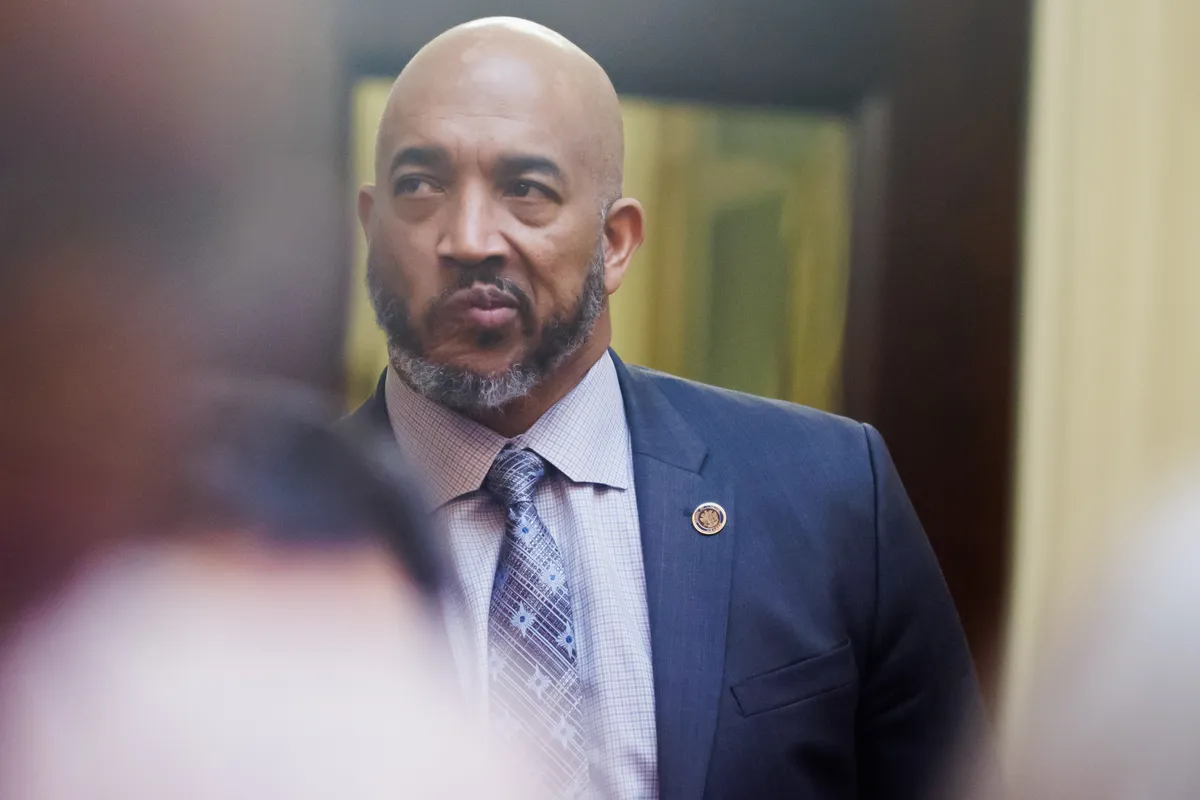
Sen. Mike Jones, D–Richmond, listens as the Senate debates the budget on Thursday, February 26, 2026, at the Virginia State Capitol in Richmond.
Some state lawmakers are calling for a ban on the automatic license plate readers.
VPM | By Dean Mirshahi
A Chesterfield County police employee has been charged with illegally using the county’s automatic license plate reader system from Flock Safety.
Rebekkah Robinson, a professional staff intelligence investigator, faces two counts for improper use of an ALPR system by law enforcement and two counts of computer invasion of privacy, according to a Friday press release.
Both are Class 1 misdemeanors.
Specific details of Robinson’s alleged crimes were not shared in the release, and a police spokesperson told VPM News that they wouldn’t comment further on the issue at this time.
State law limits police use of ALPRs for criminal investigations, human trafficking cases, when someone is missing or endangered and in a few other cases.
The incident comes as public scrutiny of ALPRs and Flock has intensified nationwide, including reports of law enforcement illegally sharing data for federal immigration enforcement and using the tech to stalk their exes.
At least two members of Chesterfield’s General Assembly delegation — Republican state Sen. Glen Sturtevant and Democratic Del. Charlie Schmidt — say they back a statewide ban on the technology.
The incident has led Chesterfield police to review “all items related to police systems” over the next 30 days, and the department said it will “make improvements where appropriate.”
“When a police employee commits a crime, it does more than just break the law, it breaks public trust in our community,” Chief of Police Frank Carpenter said in a statement Friday. “Trust is the foundation of effective policing; without it, we struggle.”
Robinson’s coworkers suspected that she was illegally using state and national crime databases and the county’s Flock cameras, police said.
They reported their concerns to leadership on Aug. 27, and an audit of her searches “uncovered suspicious transactions,” according to CCPD. Friday’s release said the department revoked Robinson’s access to all police systems.
Robinson, who police stressed is not a sworn officer, has been placed on administrative leave without pay.
Carpenter said the fact that Robinson’s alleged illegal acts were reported internally “should give confidence in the culture of the Chesterfield County Police Department.”
“We are responsible for maintaining the community’s confidence,” Carpenter said. “And when we fall short, we acknowledge it, correct it, and take concrete steps to prevent it from happening again.”
At least 20 Virginia localities have either ended or paused contracts with Flock.
Richmond Mayor Danny Avula announced plans to review the city’s contract with Flock and directed Richmond police to purge their license plate reader data every week instead of every 21 days.
“A little shocked, but also not shocked, given what we’ve seen in the news around the country,” Del. Schmidt said in a phone interview, “the number of these instances that are happening around the country, but always a little shocked when it happens in your backyard.”
Schmidt said his position against license plate readers doesn’t mean he’s anti-technology, noting the red-light cameras have helped reduce speeding in his neighborhood.
“What bothers me most about the license plate readers is law enforcement, or in some cases the staff, can get on and track people in real time,” he said. “That is dragnet surveillance that I don’t believe is constitutional.”
Schmidt said he might be more worried that Flock and other tech companies with such surveillance tools are the ones that own the cameras.
State Sen. Michael Jones, a Democrat who represents parts of Chesterfield and Richmond, told VPM News in a phone interview Friday that he believes localities should decide whether to have license plate readers.
“Every locality has different challenges, and we don’t know what they’re doing to combat challenges in their areas,” Jones said. “It’s too easy to say ban them.”
He added: “All right, so then what’s going to happen? What about real time crime centers? That’s still a real issue. They’re still going to surveil certain parts of Richmond, Virginia, more so than the other part.”
Jones said he would listen to state Sen. Lashrecse Aird (D—Henrico), a fellow Black legislator who is spearheading the effort to ban ALPRs in Virginia. But he said that white legislators haven’t spoken up about privacy concerns as Black people have dealt with a history of racist surveillance.
“This is nothing new for the African American community, and so my initial thought is, if they do away with Flock, surveillance still is going to take place in quote-unquote ‘hot spot’ areas around the commonwealth.”
“The other piece is this: Welcome to the party, white people,” Jones continued. “This is what it’s been like to be Black in this country. They weren’t saying anything about surveilling until they put flock cameras up. Do they really think that surveillance started with Flock cameras?”
Schmidt agreed that the surveillance is not a new phenomenon: “We’ve had this conversation before with body-worn cameras, drones, traffic cameras, speed cameras, red light cameras, other technology that’s used for surveillance.”
Additionally, Jones said he is planning legislation for the 2027 General Assembly session that aims to decertify law enforcement officers who violate ALPR laws.
He commended the Chesterfield police employees who reported Robinson’s behavior to their superiors: “I don’t care who you are or where you’re from, that is not easy to do.”