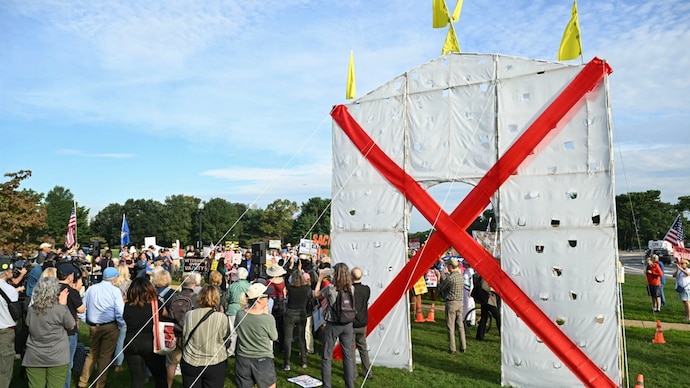


WASHINGTON — President Donald Trump’s proposed 250-foot triumphal arch near Arlington National Cemetery has been blocked by two federal judges, deepening legal challenges over the project’s authorization, potential effects on historic landmarks, traffic and public safety, and its place in Washington’s monumental landscape.
The proposed arch, planned for Memorial Circle near the Virginia end of Memorial Bridge, is intended by the administration to commemorate America’s 250th anniversary and honor military service. But opponents — including local governments, veterans, preservation advocates and members of the Kennedy family — argue that its scale and location could alter the historic setting surrounding Arlington National Cemetery and that the administration lacks authority to build it without congressional approval.
The National Capital Planning Commission approved the project’s site and building plans in an 8-4 vote Nov. 5, following extensive public testimony. Construction was halted that same day by U.S. District Judge Tanya Chutkan, who later extended her temporary order through Dec. 3.
On Nov. 20, U.S. District Judge Leonie Brinkema issued a separate injunction in a lawsuit brought by Arlington County, blocking construction indefinitely while the case proceeds. Brinkema questioned the government’s legal basis for the project and its analysis of economic and environmental impacts, including potential effects on nearby Ronald Reagan Washington National Airport, describing the review as rushed.
The administration has argued that a 1925 law authorizing work related to the Arlington Memorial Bridge provides legal grounds for the arch. Opponents contend the statute does not authorize a separate monument of this size and that federal commemorative-works law requires congressional approval.
Historic preservation, traffic and public safety concerns
Opposition has centered on the arch’s proposed height, its proximity to Arlington National Cemetery and its potential effect on the historic views connecting the Lincoln Memorial and the cemetery.
Preservation advocates and veterans argue the structure could overwhelm the surrounding landscape, interfere with sightlines and alter the solemn character of a site where generations of military personnel are buried. Members of the Kennedy family have also joined legal efforts, citing concerns that the arch could cast shadows over family gravesites, including President John F. Kennedy’s burial site and eternal flame.
Arlington County’s lawsuit raises concerns about traffic congestion and public safety, while other opponents have questioned construction disruption, emergency access and the project’s potential impact on the surrounding area.
The federal planning commission received approximately 1,300 public comments ahead of its November review, with the vast majority reportedly opposing the proposal. Critics have also questioned the project’s cost, transparency and whether federal resources should be directed toward a monument amid other public needs.
Supporters say the arch would honor military service
The White House has defended the proposal as a patriotic tribute to veterans and a lasting symbol of the nation’s 250th anniversary.
Trump has argued that Washington deserves a monumental arch comparable to those in other world capitals. Supporters, including some veterans and conservative lawmakers, say the structure would recognize military sacrifice, create a prominent national landmark and add to the capital’s commemorative landscape.
The administration has expressed confidence that the project will withstand legal challenges. White House spokesman Davis Ingle criticized the court actions, arguing that the monument is intended to unite the nation and honor those who served.
Veterans’ views, however, remain divided. Some groups have supported the arch, while others have opposed it, arguing that Arlington’s existing memorials already honor military service and that a new structure could detract from the cemetery’s significance. Disagreements over endorsements have also exposed divisions within veterans’ organizations.
A broader debate over presidential authority and Washington’s historic landscape
The dispute has grown beyond the arch’s design into a debate over presidential authority, congressional oversight, public participation and the preservation of Washington’s historic landmarks.
The administration maintains that the project has moved through federal planning reviews and can legally proceed. Opponents argue those reviews do not replace congressional authorization or adequately address the monument’s broader impacts.
With both construction injunctions in place and lawsuits continuing, the project remains on hold. The courts will determine whether the administration can proceed under its claimed authority or whether additional legal approvals are required.
For supporters, the arch represents patriotism, military service and a celebration of America’s 250th anniversary. For opponents, it risks altering a historically significant landscape, creating public impacts and advancing a major federal project without sufficient legal authorization.
The project’s future now rests on the ongoing legal proceedings, leaving the proposed monument — and the competing visions for Washington’s historic landscape — unresolved.
Trump’s 250-Foot Arch Near Arlington Cemetery Faces Two Court Injunctions, Public Opposition