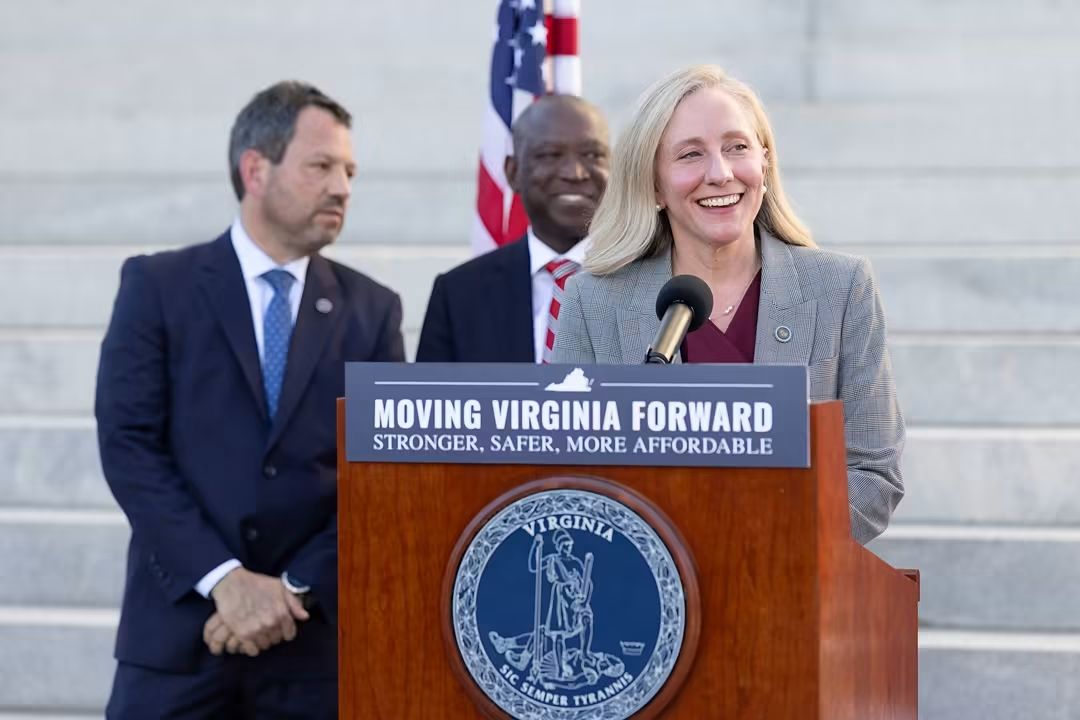


RICHMOND, Va. — Gov. Abigail Spanberger and Virginia Democrats are preparing an ambitious legislative agenda for the 2027 General Assembly session, with proposals targeting household costs, public education, workforce development, child safety, small businesses and the growing influence of data centers and artificial intelligence.
The agenda, titled “Moving Virginia Forward: Stronger, Safer, More Affordable,” outlines measures intended to ease financial pressures on families, expand economic opportunities, and strengthen protections for local communities.
Among the proposals are a medical debt forgiveness program, greater transparency in healthcare pricing, expanded affordable housing near public transportation, restrictions on unnecessary student screen time, and tighter oversight of data center development
The proposals represent the governor and Democratic lawmakers’ priorities heading into the 2027 session. They are legislative plans, not enacted laws, and will require action by the General Assembly.
Lowering healthcare, housing, and energy costs
Affordability remains a central focus of the agenda. Spanberger says her administration will build on legislation passed in 2026 by pursuing additional measures addressing healthcare, housing, and energy expenses.
One proposal would establish a medical debt forgiveness program through a partnership with a national nonprofit organization. The organization would purchase medical debt owed to Virginia healthcare providers at a reduced price and eliminate qualifying debt, following approaches adopted in states including North Carolina, Michigan, Illinois, and Arizona.
Another proposal would require healthcare providers and insurance companies to give patients good-faith cost estimates before non-emergency medical procedures, allowing consumers to better understand potential expenses before receiving care.
On housing, the administration wants to increase affordable housing construction near existing public transportation. The proposal would prioritize affordable housing and transit-oriented infrastructure when state-owned land is sold or leased.
The energy component focuses on expanding solar power without unnecessarily taking agricultural land out of production. The plan calls for stronger incentives for solar projects on previously developed or contaminated properties, known as brownfields, while expanding agrivoltaics, which allows farms to generate solar energy while continuing agricultural activities.
Changes proposed for schools and workforce development
The education agenda includes efforts to reduce unnecessary student screen time in public schools.
Under the proposal, school divisions would be required to limit excessive or low-value use of instructional technology, prioritize teacher-led instruction, and regularly evaluate how technology is being used in classrooms.
The administration also wants to expand pre-apprenticeship and youth apprenticeship opportunities for students and recent high school graduates.
The plan includes connecting underserved populations with career pathways, establishing quality standards for apprenticeship programs, and providing support such as transportation and childcare to make participation more accessible.
The broader goal is to strengthen the connection between education and employment while preparing more Virginians for long-term careers.
Child safety and emergency preparedness
The proposed public safety measures include a ban on creating, possessing, or distributing AI-generated child sexual abuse material.
The administration also wants to impose strict liability on companies or individuals providing AI platforms or models that allow users to generate and receive such material.
Another proposal would establish a Governor’s Declaration of Preparedness, an intermediate executive declaration intended to improve statewide coordination before an emergency reaches the threshold for a formal state of emergency.
The measure would build on Executive Order 19 and give the Commonwealth an additional mechanism to prepare for potential disasters and coordinate responses across agencies.
New support for small businesses
The agenda also seeks to strengthen the Virginia Department of Small Business and Supplier Diversity as a central resource for entrepreneurs and small business owners.
The department would serve as a small-business navigator, connecting businesses with funding opportunities, technical assistance, and other resources needed to grow.
The proposal is intended to make it easier for Virginia businesses to identify and access state-supported opportunities.
Tougher rules for data centers and artificial intelligence companies
One of the most significant portions of the agenda targets Virginia’s expanding data center industry and the growing use of artificial intelligence.
Spanberger says she wants to build on Executive Order 22 by establishing stronger industry standards, increasing transparency, and requiring meaningful community engagement in data center development decisions.
The proposals include prohibiting data center operators and developers from entering into nondisclosure agreements with local government employees and officials, including members of boards of supervisors, planning commissions, and boards of zoning appeals.
The administration also wants to end by-right approval for data centers using more than 25 megawatts of power, requiring local approval regardless of previous project approvals.
Water use is another major concern. Under the proposal, data centers would have to demonstrate that they have minimized water consumption for cooling. The legislation would also codify Cooling Water Scarcity Areas and strengthen state enforcement authority to protect water resources.
The agenda extends beyond data centers to employment practices involving artificial intelligence. One proposal would prohibit employers from using AI tools to set workers’ wages and salaries based on surveillance data and inferences about an individual’s financial circumstances.
The administration argues that such practices could leave workers with lower compensation based on what an algorithm determines they might be willing to accept rather than the value of their work.
A broad agenda with significant legislative questions ahead
The proposals address several issues affecting Virginia households, businesses, and local governments, but they also raise questions about implementation, costs, regulatory authority, and how new requirements would work in practice.
For example, the medical debt initiative will depend on the structure of the nonprofit partnership and which debts qualify for elimination. The housing and solar proposals will require decisions about funding, land use, and implementation.
The proposed restrictions on data center approvals could also have significant implications for local governments, developers, and communities weighing economic development against concerns about electricity demand, water consumption, and land use.
For schools, the challenge will be determining how to reduce unnecessary screen time without limiting the educational benefits of appropriate technology. Expanded apprenticeship programs will likewise depend on employer participation and the availability of training and support services.
The governor’s agenda does not provide detailed fiscal estimates, implementation timelines, or specific funding allocations for the proposals.
Ultimately, the 2027 legislative session will determine which measures advance, how they are amended, and whether they receive the funding and legislative support needed to become law.
For now, the agenda signals Spanberger and Virginia Democrats’ priorities: reducing household expenses, strengthening education and workforce opportunities, protecting children, supporting businesses and placing greater accountability on industries whose growth increasingly affects communities across the Commonwealth.
Spanberger Unveils 2027 Legislative Agenda Targeting Affordability, Schools, Public Safety and Data Center Oversight