


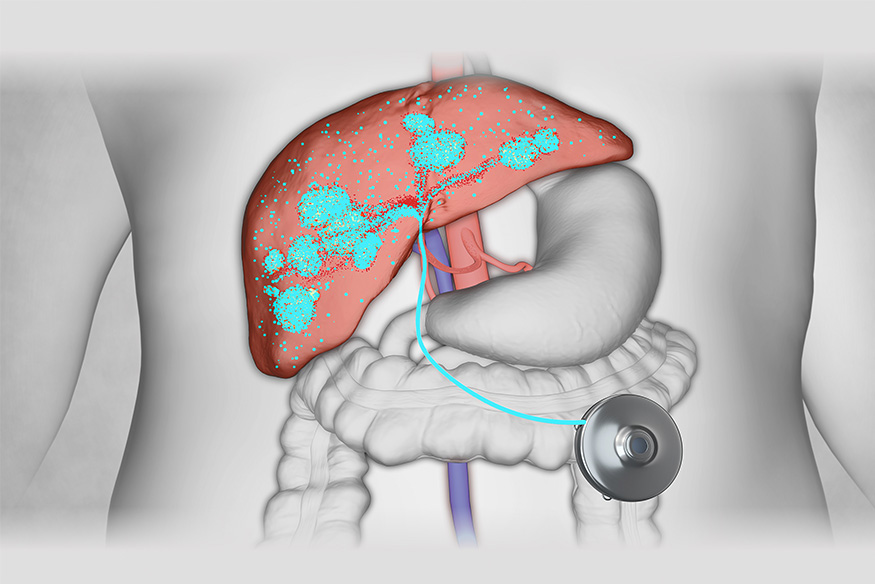
Hepatic artery infusion pump therapy is an innovative treatment option that delivers chemotherapy directly to tumors in the liver. (Image provided courtesy of Boston Scientific. ©2026 Boston Scientific Corporation or its affiliates. All rights reserved.)
VCU Massey Comprehensive Cancer Center is the first academic health institution in Virginia to offer patients hepatic artery infusion pump therapy, an innovative treatment option that delivers chemotherapy directly to tumors in the liver. This therapy is offered to patients whose tumors originated in the colon, rectum or bile duct.
The initiative to bring this treatment to Massey was spearheaded by Emily Kinsey, M.D., medical oncologist, and Ricardo Bello, M.D., surgical oncologist, in collaboration with a multidisciplinary team across VCU Health.
“We are very excited to offer this treatment to our patients. Hepatic artery infusion therapy is an option that has the potential to prolong life while maintaining quality of life,” Kinsey said. “I have seen first-hand how this approach can alter the trajectory of a patient’s disease and provide meaningful additional time for patients and their families.”
Bello added: “I think this is the fulfillment of everything that we want to do for our patients. When you see patients at any point of the spectrum of disease, you want to be able to offer them the most effective treatment for their stage. This gives us an ability to truly offer the full range of high-quality care for patients.”
Meeting an unmet need for advanced colorectal and biliary cancer
Colorectal cancer is the third most common cancer, excluding skin cancer, among both men and women in the U.S., according to the American Cancer Society. Bile duct cancer is much rarer, accounting for approximately 8,000 cancer diagnoses each year in the country. However, both tumor types commonly spread throughout the liver in later stages of disease.
For cancer patients with resectable disease—meaning the tumor can be effectively removed—surgery is the ideal form of treatment. In patients with a healthy liver, sometimes up to 80% of the organ can be removed, and the liver will grow back with restored function.
However, for those patients whose tumors have spread to a point that they cannot be removed or ablated through surgery, there are limited options for treating the liver directly without harming surrounding tissue or organs.
“There’s a huge unmet need for patients with metastatic colorectal cancer with liver lesions,” Bello said. “I like to think of hepatic artery infusion therapy as a potential bridge to resection for patients that were previously considered unresectable.”
Previous results from a phase 2 clinical trial showed that 76% of patients with colorectal-liver metastasis demonstrated an overall response to this treatment option, and nearly half of patients’ tumors were reduced to a resectable size in as little as six months after receiving hepatic artery infusion therapy.
“Patients with biliary tract cancers that are confined to the liver but cannot be resected may also be eligible for this treatment,” Kinsey said. “Encouraging data shows that hepatic artery infusion pump chemotherapy, in combination with systemic chemotherapy, may improve response rates and survival in appropriately selected patients.”
How does hepatic artery infusion therapy work?
The placement procedure can be minimally invasive and completed in coordination between surgical oncology and medical oncology specialists.
The pump is a round titanium port, similar in size to a hockey puck, which is surgically placed under the abdominal skin. The pump is connected to a small catheter that is placed into the vessels leading to the liver, and it feeds chemotherapy—floxuridine (FUDR)—directly to the liver through the hepatic artery. Because liver tumors are mostly fed by the liver arterial system instead of the portal vein system, this option preferentially treats the diseased part of the organ as opposed to the healthy tissue.
“There is a sweet spot about this medical treatment, where virtually all of the chemotherapy gets metabolized in the liver, reducing toxicity to other organs and decreasing potential for side effects,” Bello said.
Kinsey added: “Because the liver removes nearly all of the FUDR before it can pass to the rest of the body, we can deliver very high concentrations of this chemotherapy directly to the liver—hundreds of times higher than we typically can give to patients systemically.”
The patient gets their pump refilled every two weeks, either with chemotherapy or a saline solution that flushes out and keeps the catheter open. The pump is not battery-powered, but is instead driven by the patient’s body heat and affected by altitude, so patients are instructed to avoid hot tubs and long, warm baths, and should alert their care team before airplane travel.
“It is very important for patients to have close follow-up care and for them to be willing and able to travel to Richmond,” Kinsey said. “Staying on schedule is very important. If the pump isn’t refilled every two weeks, it can run dry, which can prevent it from being used in the future.”
This treatment requires specialized collaboration between experts in medical oncology, surgical oncology, infusion, pharmacy, nuclear medicine, and radiology to ensure the best outcomes for patients.
“Multidisciplinary cancer care offered at institutions like Massey is crucial. It’s a matter of survival,” Bello said. “Good communication between specialties allows us to adjust doses, timing and anything else that needs to be done, as well as improve training initiatives, so that our patients can get the effective treatment they need but also get it safely.”
Kinsey said that launching this program took years of planning and was truly a collaborative effort that involved a highly dedicated team of nurses, pharmacists, physicians and many others.
“We are incredibly grateful for the commitment and enthusiasm of the entire team, as well as the support of Massey leadership, who made it possible to bring this treatment option to our patients,” Kinsey said.
Massey is the only National Cancer Institute-designated comprehensive cancer center in Virginia to offer this treatment. The first patient at Massey received a pump in October 2026, which was inserted robotically by Leopoldo Fernandez, M.D. The patient has since returned to receive their first FUDR chemotherapy treatment with Kinsey.
What’s next
In the future, Bello is hopeful that different therapies for other types of advanced tumors can be delivered through this system, as the liver is a primary site for the spread of many forms of cancer.
“We’re excited to start finding ways in which we can also be contributing as thought leaders and clinical researchers to best treat different kinds of patients with this option,” Bello said.
Kinsey said the goal is to grow the program and expand access to hepatic artery infusion therapy to patients throughout Virginia.
“As the program grows, we hope to incorporate clinical trials and research to improve how we select and treat patients,” Kinsey said.
Written by: Blake Belden
