

By Nathaniel Cline
(VM) – Leading Democratic leaders urged Gov. Glenn Youngkin to suspend any further appointments to Virginia’s university governing boards, after a state Senate committee rejected 14 of his appointments on Thursday.
The committee has axed a total of 22 Youngkin appointments, including the ones on Thursday and eight rejected in its June meeting.
Virginia law grants governors the authority to appoint individuals to approximately 300 public commissions and boards, including ones at institutions of higher learning. However, the governor and Democrats have not seen eye-to-eye on board appointments at several universities, ultimately leading to rejected appointees and an ongoing legal dispute.
On Thursday, the Senate Committee on Privileges and Elections rejected 14 appointments: four for the Virginia Military Institute (VMI), four for the University of Virginia (UVA) and its affiliates and six for George Mason University (GMU). Youngkin made the appointments to fill vacant positions on their respective boards.
“This unprecedented level of rejection reflects not partisan obstruction, but genuine concerns about the qualifications, backgrounds, and intentions of your appointees,” Majority Leader Scott Surovell, D-Fairfax, President Pro Tempore Louise Lucas, D-Portsmouth, and Senate Democratic Caucus Chair Mamie Locke, D-Hampton, wrote in a letter to Youngkin on Thursday. “The pattern of inappropriate nominations and acquiescence to outside political influence has created significant uncertainty and instability within our higher education system at a time when these institutions need steady, qualified leadership.”
Senate leaders wrote that they have serious concerns regarding his appointments, who they said have introduced additional “controversy” and “division,” and have “abdicated” their responsibilities. They wrote that Virginia’s universities need members who “unite rather than divide,” possess relevant experience in higher education governance, and are committed to protecting academic freedom and institutional integrity.
One of the earlier rejections included former Virginia Attorney General Ken Cuccinelli, a former deputy secretary of Homeland Security under President Donald Trump’s first administration. Committee Chair Aaron Rouse, D-Virginia Beach, said earlier he could not support Cuccinelli’s board appointment because of his “extreme” position on reproductive rights, his work on Project 2025 — a conservative plan for how the country should be run under Republican control — and his “hateful attacks” on LGBTQ Virginians, factors against Democrats’ ideals.
In response to the committee’s decision on Thursday, Youngkin said its eight Democratic members continued their “partisan campaign to irreparably harm higher education in Virginia” by blocking the appointments.
“In my view, a single Senate committee does not have the legal authority to perform duties that the Constitution and Code explicitly assign to the full General Assembly,” Youngkin said in a statement Thursday. “This important constitutional question is now before the Supreme Court of Virginia, and I am confident in our position.”
He added that the committee was “damaging” Virginia’s great institutions of higher education and that removing the “talented, experienced, and dedicated” appointees is “an unprecedented” breach of public trust.
“Even more concerning, they refused to provide Virginians with any explanation for their decision,” he said. “This is blatant partisanship that damages our great universities.”
On June 15, the Senators fought to keep other rejected appointments off the boards by successfully urging a Fairfax County Circuit Court judge to grant a temporary injunction suspending eight gubernatorial appointees from serving on governing boards at GMU, UVA and VMI.
Attorney General Jason Miyares has appealed the decision to the Supreme Court.
The senators also requested that the governor suspend further appointments until he can have “meaningful consultation” with Senate leadership.
However, Sen. Glen Sturtevant, R-Chesterfield, a member of the committee, said that while dialogue is good, he questioned his colleagues’ motives if they continue to reject appointments.
“I think it’s great for everybody to be talking, and they should,” Sturtevant said, but “I don’t know what would come to fruition from those (conversations) if the folks on this committee can’t vote for those individuals, I don’t know who they could vote for.”
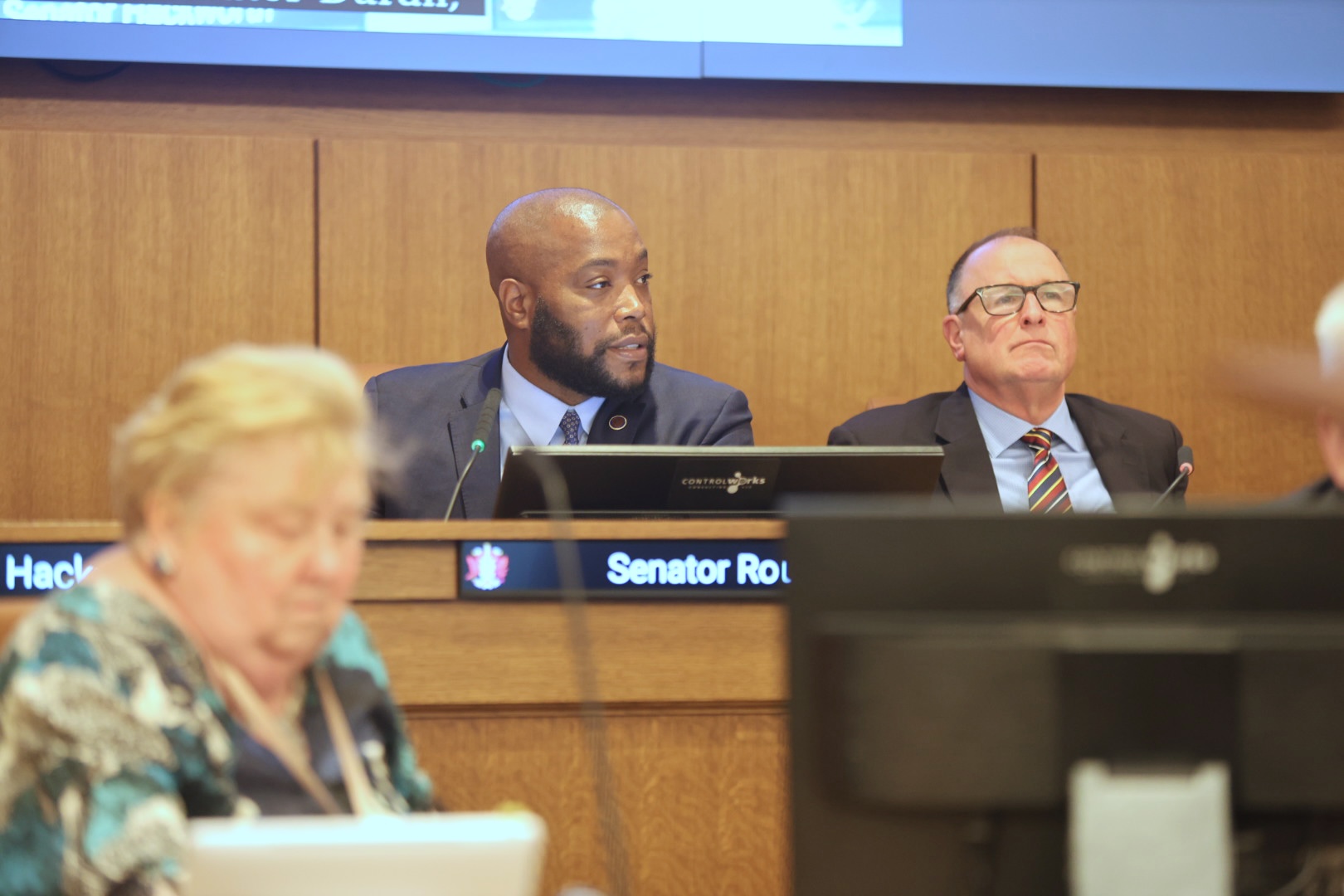
During Thursday’s meeting, which wrapped up in under 10 minutes, Republican members expressed concern about the politicization and removal of the appointees, two of whom own a prominent business and served in the General Assembly.
They also questioned why the committee would take up the appointments when the Supreme Court is determining whether eight of the previously rejected appointees can still serve.
“Why would we not wait for the Supreme Court to rule on this?” asked Sen. Bill DeSteph, R-Virginia Beach.
Sen. Tara Durant, R-Fredericksburg, added that the committee has “a long list of people who got quite a wealth of experience, and I think the broader question it begs is what will happen in the future to dissuade those who are willing to serve the commonwealth in this capacity, and we can see now that it’s becoming a lot more politicized.”
The committee voted 6-8, rejecting the resolution to accept the appointments.
“We have a job to do as this committee, not only to protect our colleges and universities, but to make sure that appointees or potential appointees are upholding the values and principles set forth by members of the commonwealth and members of this board,” Rouse said to reporters after the brief meeting.
Youngkin’s term ends in January, after which time Lt. Gov. Winsome Earle-Sears, the Republican nominee, or Democratic nominee Abigail Spanberger will take office, giving them the power to make appointments or even terminate them.
Youngkin exercised this option in March when he fired businessman Bert Ellis from UVA’s board, though he did not expand on why. He only stated that “on many occasions” Ellis violated the state’s Code of Conduct for state boards and commissions, and the Board of Visitors’ Statement of Visitor Responsibilities.
Senate committee Democrats block 14 more Youngkin appointees from Va. college boards