

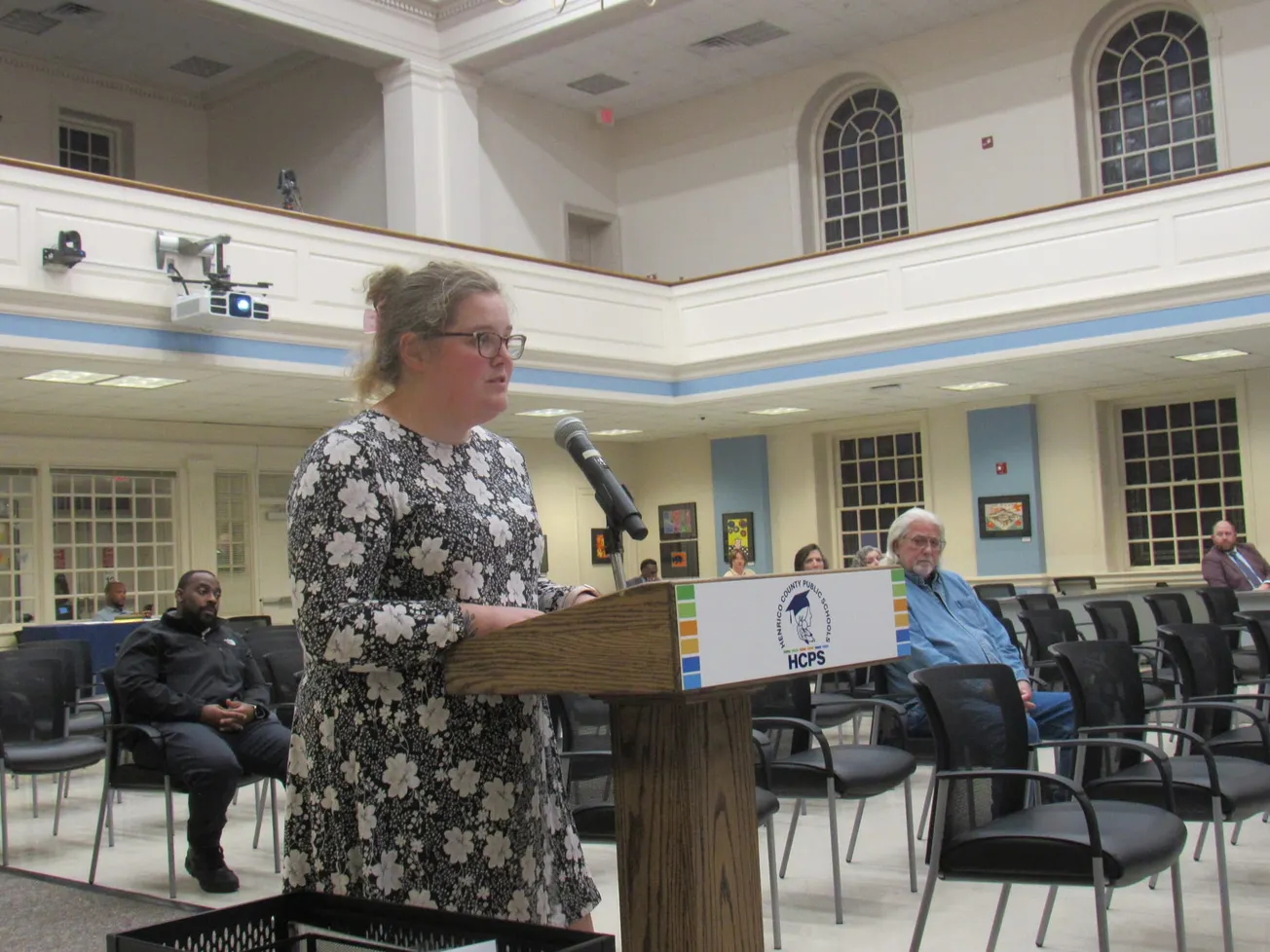
Skipwith Elementary teacher Emily Lancaster addresses the Henrico School Board during public comment at a meeting Thursday. (Liana Hardy/Henrico Citizen)
At Thursday’s Henrico School Board meeting, several parents and teachers pushed the school board and Superintendent Amy Cashwell to “take accountability” for the widespread HVAC issues the division has experienced.
Earlier that day, Henrico Schools released a video on its YouTube page with Cashwell apologizing to parents and staff about the frequent AC outages and promising a more proactive approach to maintenance during this school year. HCPS also released the video on the Parentsquare app on Wednesday night for school communities.
But Jessie Walsh, a parent of two students at Maude Trevvett Elementary, said that the video was simply “reiterating the same information” shared at the last school board meeting Sept. 10, with no new updates on when students and staff will start seeing conditions improve.
“There is a lack of transparency and a lack of communication for these parents. Timelines have not been consistently provide to parents as to when the issues would be fixed,” she said. “When something affects hundreds of students in the school system, it becomes a matter of public concern.”
Walsh said that she and other parents were not aware of HVAC issues until the back-to-school nights held the week before the first day of the school year. Earlier this month, HCPS spokesperson Eileen Cox said that as many as 18 schools in the division, sometimes more, have been experiencing AC outages on any given day.
Cashwell also cited HVAC issues at a number of other school divisions in the country, saying that HCPS was not alone in facing AC equipment delays and workforce shortages. But former Skipwith Elementary teacher Lauryn Galloway said the message felt like Cashwell giving excuses rather than taking accountability.
“We do not care what is going on in other counties,” she said. “In my five years teaching at Henrico, the HVAC has gotten worse with every year…we don’t want to hear your performative positivity or your excuses. You all are acting like this is brand new information.”
Galloway asked that HCPS post a daily audit trail documenting the steps being taken to resolve AC issues to publicly prove that improvements are underway.
“The only reason anything is being done with urgency now is because the news pulled the curtain back for everyone to see,” she said. “This has been a years-long issue, and until you acknowledge that and admit that it has been poorly handled by you, we cannot trust anything you say.”
In her video, Cashwell said that HCPS’ new proactive maintenance plan included a new $3.9-million joint contract with county government that would ensure preventative maintenance on HVAC systems at every school building four times a year. HCPS will also be adding five new HVAC technician positions and two new facilities leadership positions this year.
The division still has a backlog of deferred maintenance projects costing $92 million, Cashwell said.
Parents also express concerns about computer and tablet use in schools
HCPS parent Marian Raecke, who has a daughter in second grade at Gayton Elementary, said she also wanted Cashwell and the school board to take further action on limiting technology use in schools, particularly for the youngest grades in elementary schools.
In August, HCPS leaders outlined new guidelines that would set official screen time limits for each grade level in elementary schools and ban digital homework at the elementary level, requiring Chromebooks and iPads to stay at school. HCPS’ one-to-one technology policy provides pre-kindergarten and kindergarten students with their own iPad and students in grades 1-5 with their own Chromebook.
But Raecke encouraged the board to set limits beyond the elementary grades, ensuring that middle- and high-schoolers also have restricted screen time and guided use of technology. Currently, there are no screen times enforced at the secondary level.
“I would ask the board to go further and develop a clear, age-appropriate philosophy for school-issued tech across K-12,” she said. “Please do not let this conversation end with elementary school students. My daughter will be a middle-schooler in a few short years, and I hope that I am not having to stand before the board again, advocating for the same changes.”
Raecke also encouraged the board to release a public audit documenting how much time students in each grade actually spend on devices during the school day.
Instead of speaking out on issues within the school division, many HCPS teachers stay silent because of fear of retribution, said Skipwith Elementary teacher Emily Lancaster. When teachers do voice their concerns, division leaders do not pursue any changes, she said.
“You do not value your teachers,” Lancaster said. “if you value your teachers, you would hear them when they tell you that something is wrong, whether it’s the HVAC, the overuse of technology, the literacy curriculums, the lack of support with behaviors, the class sizes – I could go on and on. And in fact, there are some other things that show you that your system might be broken.”
Liana Hardy is the Citizen’s government and education reporter. Support her work and articles like this one by making a contribution to the Citizen.