


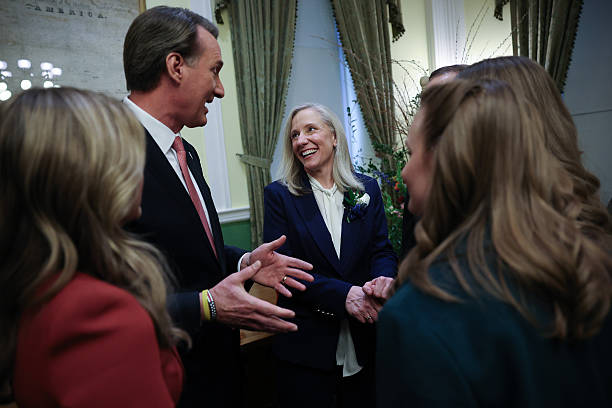
Gov. Abigail Spanberger and former Gov. Glenn Youngkin
Gov. Abigail Spanberger announced Friday that her administration has restored voting and other civil rights to more than 66,000 Virginians with past felony convictions since taking office in January, marking a significant shift from the policies of the previous administration.
According to the governor’s office, the rights of 66,085 Virginians have been restored during the administration’s first six months. Those restored rights include the ability to vote, serve on juries, run for public office, and become a notary public.
Virginia is one of only three states where people convicted of felonies do not automatically regain these civil rights. Instead, the Virginia Constitution gives the governor the authority to restore them on an individual basis.
Spanberger said the restoration effort reflects her administration’s commitment to helping Virginians who have completed their sentences rejoin civic life.
“The right to vote is foundational to who we are as Americans,” Spanberger said in a statement. “These Virginians deserve the right to use their vote, make their voices heard, and be recognized as contributing citizens to our Commonwealth and country.
“The announcement also drew a contrast with former Gov. Glenn Youngkin’s administration. Spanberger said her predecessor dismantled a streamlined restoration process that had been used by previous governors of both political parties. Her administration says it has reinstated a system that both reviews applications and proactively identifies eligible Virginians whose rights can be restored.
Secretary of the Commonwealth Candi Mundon King said the administration has worked to review each case while coordinating with law enforcement agencies to verify eligibility.
“Today is an important day for the Commonwealth and the more than 66,000 Virginians who now have their voting rights restored,” King said.
The announcement comes as Virginia voters prepare to decide a constitutional amendment this fall that would automatically restore voting rights to individuals convicted of felonies once they are released from incarceration. If approved, the amendment would remove the governor’s role in restoring voting rights, although other civil rights could remain subject to existing constitutional provisions.
Supporters of the amendment argue that automatic restoration would eliminate a system rooted in Virginia’s 1902 Constitution, which historians have linked to the state’s Jim Crow era. Opponents have argued that governors should continue exercising individual discretion when determining whether voting rights should be restored.
Early voting for the November 3 election begins Sept. 18.
The Spanberger administration also announced that Virginians seeking restoration of their rights may continue to apply through an online application system that officials say has been simplified by removing additional questions added during the Youngkin administration.
State lawmakers supporting the governor’s efforts praised the announcement. Sen. Mamie Locke called restoration of rights “an important responsibility,” while Del. Cia Price said she hopes voters will approve the proposed constitutional amendment in November.
Virginia has relied on gubernatorial restoration of rights since the adoption of its 1902 Constitution. While governors of both parties have restored rights over the past two decades, administrations have differed significantly in how broadly and proactively they have exercised that authority.

COMMENT
This is good governance. Please keep it up! Does committing a felony negate your citizenship? If not, a person, incarcerated or not, should be able to vote. Unless/until all people who commit the same crime are punished equally, justice is not just.
Comments are closed.