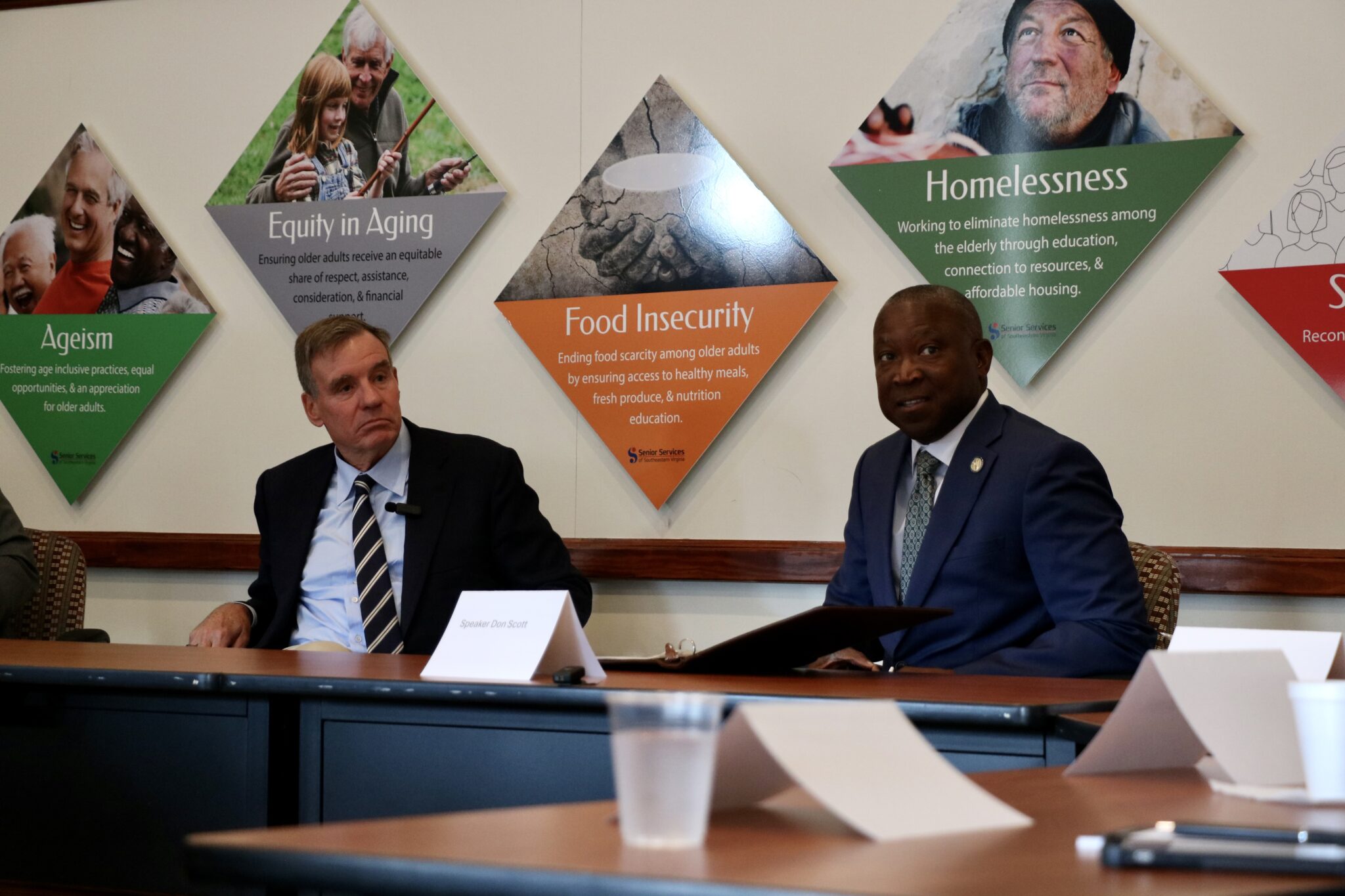


U.S. Sen. Mark Warner, D-Virginia (left) and Virginia House Speaker Don Scott, D-Portsmouth (right) participate in a healthcare roundtable discussion at the Hayden Village Center in Franklin, on Sep. 2, 2025. Photo by Charlotte Rene Woods/Virginia Mercury
By Charlotte Rene Woods
(VM) – FRANKLIN, Va. – Alongside local health care workers and government leaders Tuesday morning in Franklin, Democrat Mark Warner, who represents Virginia in the U.S. Senate, and Virginia House of Delegates Speaker Don Scott, D-Portsmouth, delivered warnings about looming federal funding changes that will affect health care access and affordability in the years ahead.
Both lawmakers expressed frustration with some hospital chains in Virginia for not speaking out about how the “One Big Beautiful Bill Act” reconciliation bill that Congress passed this summer will impact health care providers and patients in the state.
“They’re trying to bury their heads in the sand,” Warner said of some health systems operating in the commonwealth. “They want to lobby me and the Speaker for help behind closed doors, but don’t want to go out and be transparent with their community.”
Scott concurred. The men surmised that hospital leadership may be feeling “intimidated” by President Donald Trump’s administration, which has spearheaded a campaign to reduce government spending that has upended several agencies and led large swaths of federal workers to lose their jobs, including thousands in Virginia.
Referencing Trump’s “Make America Great Again” campaign slogan, Scott said “the greatness of this country will only be maintained if we’re willing to speak truth to each other.”
Both on the panel in Franklin — an hour and a half southeast of Richmond — and in an interview with The Mercury, Warner singled out Bon Secours, which the area’s operates Southampton Memorial Hospital, one of six hospitals in the state that could be at higher risk of service cuts or closure when health care components of Congress’ reconciliation bill take effect.
When The Mercury reached out to Bon Secours about Southampton earlier this summer, a public relations person referred the newsroom to the Virginia Hospital and Healthcare Association. The entity includes several health systems around the state and at times speaks on their behalf. In June, VHHA had joined several similar associations in other states to write a letter to Congress urging them to block the U.S.Senate’s version of the reconciliation bill before it ultimately passed and was signed into law by Trump on July 4.
Aside from the letter, leaders from hospitals have made visits to Washington, D.C. to meet with federal lawmakers and the White House. VHHA spokesman Julian Walker said in an email that the association and hospitals have “consistently shared our perspective” about how the bill could cause hundreds of thousands to lose health coverage and a projected “$2 billion annually in essential hospital funding.”
While Bon Secours hasn’t spoken about the imminent changes publicly, Ballad Health leaders have spoken out.
“Obviously it’s a huge concern for us,” Lee County Community Hospital administrator Cindy Elkins told The Mercury during a visit this summer to the facility deep in the mountains of Southwest Virginia.
A once-shuttered facility, Ballad Health took over and reopened the hospital in 2021. On a recent tour, Elkins explained how the facility has been able to add new services incrementally over time to serve some needs of the rural communities it serves.
While still vulnerable to the loss of Medicaid-insured patients, the hospital’s special reimbursement rate through its designation as a Critical Access Hospital is expected to cushion some of the reconciliation bill’s blow.
Ballad Health’s Chief Operating Officer Eric Deaton also spelled out that the forthcoming changes are “pretty scary.”
He predicts Ballad could lose around $25 million in the first year the reconciliation bill’s hospital funding changes take effect. Ballad is one of the chains that has a footprint in rural areas, which can be less profitable for hospitals and make operating margins small, but which Deaton said is “a calling” for some physicians and hospitals.
“We’re very concerned, and we’re really focused on, ‘what can we do to work with our legislators in the future?’” he said.
Ballad Health CEO Alan Levine was also critical of the reconciliation bill on social media as it worked its way through Congress — at one point, writing that it “will lead to closure of rural hospitals.”
More uninsured Virginians, fewer health care workers and services
How the reconciliation bill’s changes will take shape in Virginia depend on a series of interconnected federal funding changes. One is a set of federal funding mechanisms that are critical to hospital operation, while the other changes stem from forthcoming Medicaid shifts outlined in the federal legislation.
Of Virginia’s roughly 1.9 million people on Medicaid, about 600,000 of the people who became eligible when the program was expanded in 2018 could potentially lose coverage.
Then there’s the potential for Congress to not renew special tax credits that help people purchase insurance on the ACA Marketplace, which may cause some to forgo purchasing plans next year altogether. About 400,000 Virginians purchase health insurance on the marketplace, with the credits applying to those that earn between 100% and 400% of the federal poverty level.
Uninsured people are less likely to seek preventative care and wait for dire emergencies to get help. That care can become costlier and hospitals will absorb it for a time, but will also find ways to offset costs.
Aside from reducing staff and services or closing facilities, hospitals do occasionally negotiate with private insurers, which means that those rates are likely to rise in the future.
“They’re going to drive up all of our rates,” Warner said Tuesday in Franklin. “This will drive up healthcare costs for all of us — rich, poor, middle class and anywhere in between.”
Passing the message
Tuesday’s panel included area doctors, healthcare advocates, and local government officials who strategized how to best communicate and prepare Virginians for the changes coming from the new federal law.
Scott said that city councilors and boards of supervisors can play a key role in educating people, to which Franklin Mayor Paul Kaplan nodded. Mona Murphy, a local public school employee, noted that the local hospital is a “fundamental pillar” of the local workforce. Its potential closure or downsizing would leave people without jobs, a point that is essential for the public to understand, she said.
An audience member suggested state lawmakers explore requiring hospitals that plan to close down to fund an urgent care center in their absence. Scott said he “liked the idea,” but noted that hospitals that end up closing could also explore converting themselves into an urgent care center.
For now, he said that Virginia could tap into its budget surplus, but as a short-term fix, it would be “wiped away with the stroke of a pen.”
When passing the reconciliation bill, Congress also passed the Rural Health Transformation Program, which Walker from VHHA acknowledged was meant to “soften the (the reconciliation bill’s) impact on patients and providers.”
He added that that the association’s “outreach continues today as we engage with state and federal officials” regarding the program. In Virginia, state and local agencies are already preparing for how to roll out the changes.
Scott and Warner criticized Congress’ Republican majority for delaying the start date on health care changes in the reconciliation bill until after next year’s congressional midterm elections. Between now and then, Warner said he is hopeful that the nation’s legislative body can consider unraveling some of those changes. More immediately, however, he plans to urge his colleagues across the aisle to to renew the ACA tax credits so hundreds of thousands of Virginians won’t lose their health care insurance.
“I do think a lot of my Republican friends realize that the big bill went too far,” he said. “So maybe I think we can get some agreement there.”
Federal, state lawmakers call on Va. hospitals to ‘be transparent’ about federal funding changes